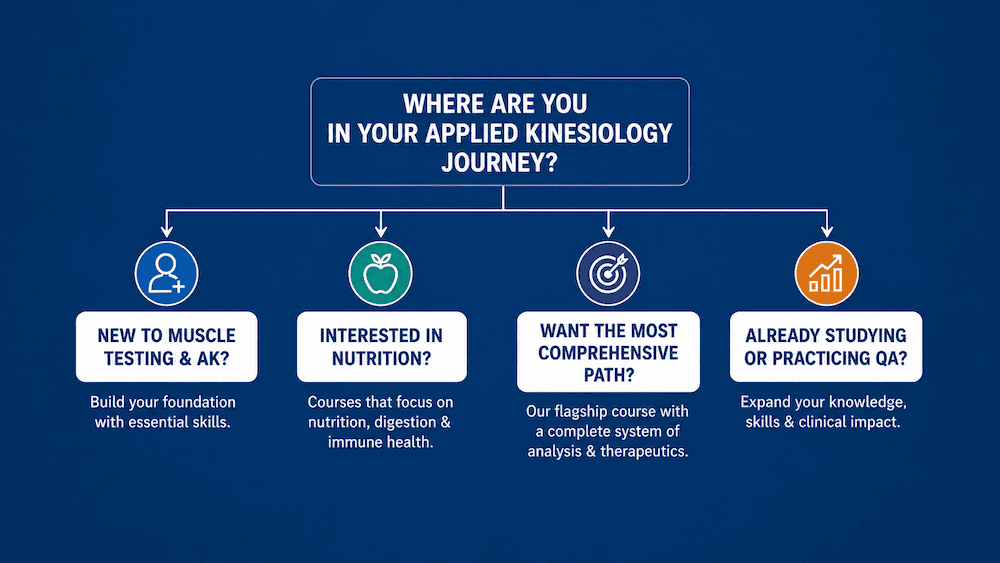
There’s a lot to explore at QA Home Study, and not everything will be right for everyone.
Some courses are perfect for practitioners just getting started with muscle testing. Others are designed for experienced AK practitioners, nutrition-focused clinicians, or those ready to go deeper.
So where do you fit? This guide will help you figure that out.
Use this page as a map. Find the section that sounds most like you, read about the courses that apply, and follow the links when you find something you’d like to explore further.
A Quick Guide to Where to Start
New to manual muscle testing or Applied Kinesiology? Start with the foundational options below, including Muscle Testing Training, the AK 100-Hour Course, and the QA Course.
Primarily interested in clinical nutrition, digestive issues, or immune-related issues? You’ll find courses designed for you that don’t require previous AK or manual muscle testing experience.
Looking for the most comprehensive option, whether you’re new to AK or already experienced? Take a close look at the QA Course. It teaches manual muscle testing, the clinical techniques, and the systematic thought process for determining what to address first, next, and last.
Already studying or practicing QA and ready to go further? Explore the QA Enhancement Webinar Library, Brain On Fire, and other specialized clinical programs.
Looking for one particular clinical skill, subject, or resource? You’ll also find specialized courses and clinical resources that you can select based on your individual needs.
The QA Course is our flagship and most comprehensive clinical program, but it isn’t necessarily where every practitioner needs to begin. Some courses provide foundational training, others address specific clinical interests, and still others are designed to expand on QA once you’re already studying or using it. The right starting point depends on what you already know and what you want to accomplish next.
Now, let’s look at each path in more detail.
If You’re New to Manual Muscle Testing and Applied Kinesiology
If you have little or no experience with manual muscle testing or Applied Kinesiology, you have several places you can start.
If your goal is to learn manual muscle testing and Applied Kinesiology (AK), the courses below provide several ways to begin, depending on how much you want to learn and how comprehensive you want your starting point to be.
You do not have to master manual muscle testing before beginning either the AK 100-Hour Course or the QA Course.
However, developing some proficiency with muscle testing first can make learning easier by allowing you to focus on the broader clinical concepts and their application without trying to develop your muscle-testing skills at the same time.
From there, you can choose the starting point that best fits your current experience and goals.
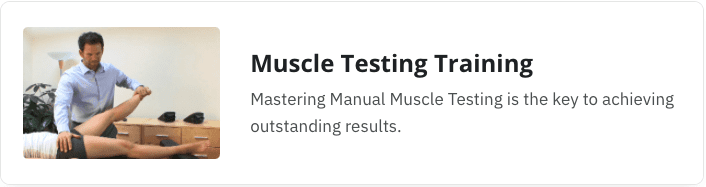
Muscle Testing Training
Best for practitioners with little or no muscle-testing experience, or anyone who wants a convenient muscle-testing reference guide to hone their skills.
Muscle Testing Training is designed as a fast-start course in accurate muscle testing. The muscles are arranged for quick access, with instruction on how to test each muscle, complemented by relevant clinical information.
The course is taught by Dr. Robert Ciprian, an ICAK Diplomate.
Muscle testing is also taught in both the AK 100-Hour Course and the QA Course, so you don’t need to purchase this course to get access to muscle-testing instruction.
Its advantage is focus and convenience. Instead of learning muscle testing while simultaneously learning everything else in a larger context, you can concentrate on developing the testing skill itself.
This is probably for you if you’ve never tested muscles and want to become comfortable with the basic skill before or while taking a more comprehensive AK course.
You probably don’t need it if you’re already proficient in manual muscle testing.
Injury Recall Technique (IRT) Fast Start Program
Best for practitioners who want an inexpensive introduction to arguably the most powerful technique taught in the AK 100-Hour Course and QA Course.
The introductory Injury Recall Technique lecture is taken from the first session of the QA Course, so its fundamentals are exactly what you would receive from the QA Course itself.
IRT is one of four powerful hands-on pain-relief techniques taught in the first session of the QA Course. The $17 IRT introductory lecture is complemented by bonus IRT training and webinar outtakes that enhance your understanding and application of Injury Recall Technique.
This isn’t a substitute for learning Applied Kinesiology or for taking the QA Course. Think of it instead as a window into the kind of masterful clinical work taught in QA.
This is probably for you if you’d like to experience a specific, easily applied, and powerful technique that can be integrated into whatever your practice type is, before committing to a larger program of study.
You probably don’t need it if you have already purchased the AK 100 Hour Course, QA Session 1, or the QA Course where IRT is taught in all of its applications.
AK 100-Hour Course
Best for practitioners who want a substantive foundation in Applied Kinesiology before moving on to the QA Course, where Dr. Schmitt expands on these concepts with a special focus on a physiologically based, basic science-driven hierarchy for clinical decision-making.
The AK 100-Hour Course is the foundation upon which Dr. Walter Schmitt ultimately created the comprehensive QA Course. It consists of eight recorded sessions of approximately 12.5 hours each.
The course covers fundamental AK principles, manual muscle testing region by region, gait analysis, the cranium and TMJ, structural, emotional, and biochemical assessment and treatment procedures, and more.
The notion of an introductory “100-hour course” has been part of the Applied Kinesiology lexicon since the 1970s. This is Dr. Schmitt’s updated version of that foundational training.
One important distinction:
The AK 100-Hour Course teaches the techniques and fundamentals of AK in the 21st century. The QA Course goes further by expanding on these concepts and organizing clinical evaluation and treatment into an ordered system of analysis and therapeutics.
The good news if you decide this is the starting point for you: If you later move on from the AK 100-Hour Course to the comprehensive QA Course, the price you paid for the AK 100-Hour Course will be credited toward the QA Course.
That means you don’t have to choose between “starting cautiously” and “buying the complete system” simply because you’re worried about paying twice.
This is probably for you if you’re relatively new to AK and want a thorough foundation that provides a context for clinical thinking that is nowhere else to be found.
You may want to go directly to the QA Course instead if you’re already comfortable with AK and your main problem isn’t learning more techniques, but knowing what to do first, next, and last.
Critical Concepts for Effective Care
Best for practitioners who have been introduced to the foundational concepts taught in the AK 100-Hour Course and want the companion material that followed.
The seminar Critical Concepts for Effective Care was taught to complement and augment the AK 100-Hour Course, essentially serving as an additional session beyond the original eight.
Because of that, this is not the course we’d normally recommend as your first introduction to AK.
If you’re starting from scratch, look at Muscle Testing Training, the AK 100-Hour Course, or the QA Course instead.
The Extremities Course
Best for chiropractors and other structurally oriented practitioners who want focused instruction on extremity adjusting.
Taught by Dr. Robert Ciprian, the Extremities Course covers adjusting techniques for the wrist, elbow, knee, foot, and shoulder.
This is a focused skills course rather than a complete AK curriculum, which makes it a useful add-on to broader training such as the AK 100-Hour Course.
This is probably for you if you’re specifically looking to improve your extremity adjusting skills.
This is not the place to start if what you’re looking for is an introduction to manual muscle testing and Applied Kinesiology.
If You Practice Nutrition But Don’t Use Muscle Testing
Not everything at QA Home Study requires an Applied Kinesiology background.
Several courses use what we call indicator testing rather than relying on manual muscle testing. These courses are useful to all practitioners but are especially directed toward those who use nutrition in their practice and have no previous manual muscle testing experience.
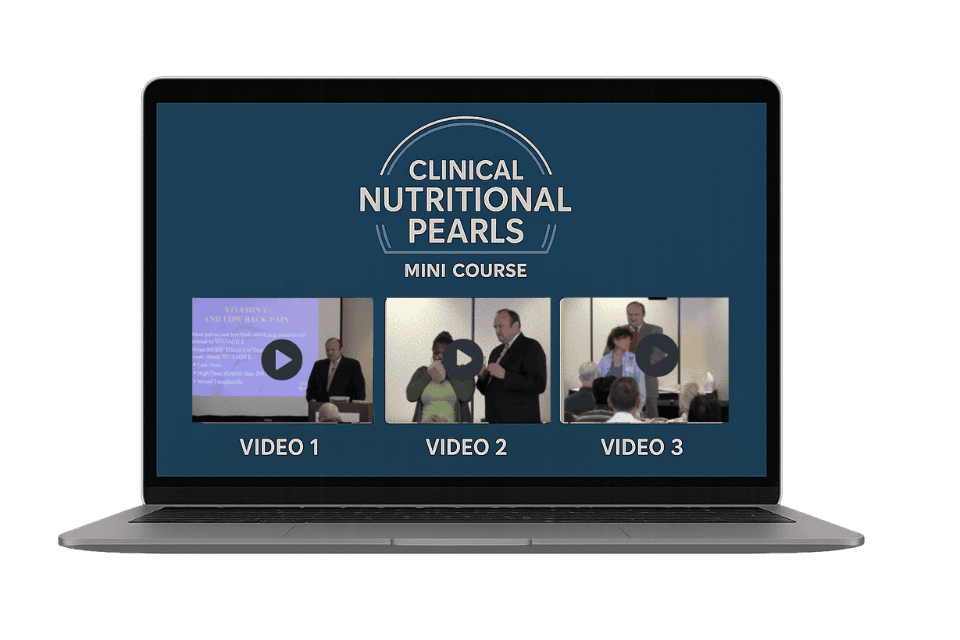
Clinical Nutritional Pearls 1 & 2
Best for practitioners who want practical clinical nutrition training from a unique perspective, with measurable in-office outcomes to help direct their therapeutic approach, without needing any background in AK or manual muscle testing.
Clinical Nutritional Pearls 1 & 2 teach indicator testing to verify, in the office, the effectiveness of specific nutritional therapies prescribed for the individual patient.
The complete program contains nearly 20 hours of clinical education divided between two enlightening sessions with comprehensive discussion, demonstrations, and workshops.
If you’re not sure whether this approach is relevant to your practice, our free mini-course lets you sample the curriculum before purchasing the complete program.
This is probably for you if nutrition is an important part of your practice and you’d like additional confirmation for determining nutritional priorities for each patient.
You do not need Applied Kinesiology or manual muscle testing experience.
Immune System & Digestive Mastery
Best for practitioners who frequently see patients with digestive and immune-related issues and want to uplevel their clinical expertise.
This program combines focused training on digestive disorders and immune-system modulation.
Like Clinical Nutritional Pearls, it uses indicator testing methods and does not require a background in AK or manual muscle testing.
A free mini-course introduces several concepts from the two seminars, including indicator testing and the immune-TMJ connection, ileocecal valve dysfunction and low-back pain, and assessment for food sensitivities.
This is probably for you if digestive and immune issues make up a significant portion of your patient population.
This probably isn’t your first choice if you’re looking to learn AK and manual muscle testing.
Mastering Medications
Best for practitioners who want a better understanding of medications, their side effects, and potential alternatives for patients who may be taking them.
Taught by Dr. Christopher Montanaro, a Diplomate in Applied Kinesiology and a Nurse Practitioner, Mastering Medications covers cardiovascular, antibiotic, and mental-health medications.
A background in AK or manual muscle testing is not required.
This webinar series is relevant for all healthcare practitioners, especially those who don’t prescribe medications themselves. If your patients take medications and you want a better understanding of what those medications do, this training will be useful.
This probably isn’t for you if you’re looking for further instruction in Applied Kinesiology techniques and procedures, though some are mentioned.
The QA Course: A Comprehensive System of Analysis and Therapeutics
Whether you’re new to Applied Kinesiology or already have years of experience, the QA Course provides the most comprehensive path through the QA Home Study curriculum.
For practitioners new to AK, QA teaches the skills and techniques needed to apply the system, including manual muscle testing. For experienced AK practitioners, it addresses an additional challenge: how to organize and prioritize the many techniques and procedures you already know.
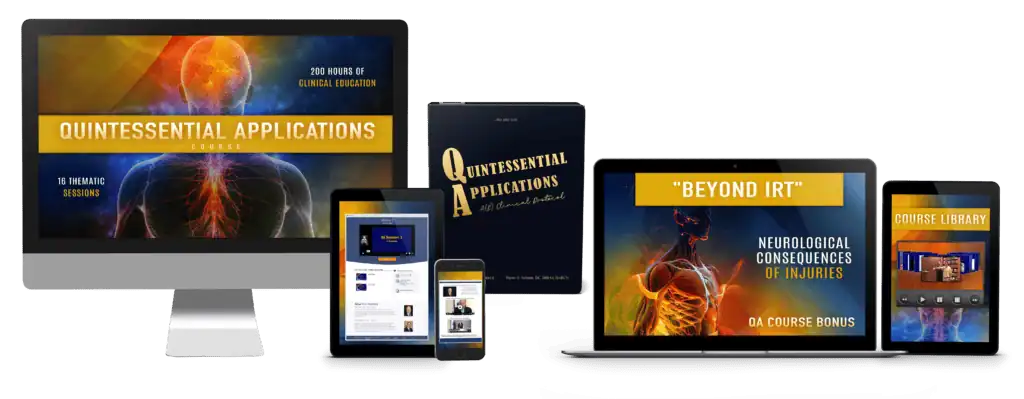
Quintessential Applications (QA) is our flagship 16-session course, featuring a comprehensive clinical protocol designed to help you determine what to do first, next, and last, and why, with each patient you evaluate and treat.
The reason that the QA Course exists is much more important than the number of sessions it contains.
If you are familiar with Applied Kinesiology, you know that it has given practitioners an extraordinary number of techniques, procedures, and clinical tools to address a host of problems.
However, it does create another problem:
Which One Of Those Techniques or Procedures Do You Do First?
An AK practitioner may know how to test dozens of muscles and evaluate structural, biochemical, and neurological factors. But that knowledge doesn’t necessarily answer the most important clinical question: What matters most for this patient, right now?
The QA Course addresses and answers that very question.
Rather than simply adding more techniques and procedures, the QA Clinical Protocol organizes and prioritizes clinical care into 32 steps based on a neurological and biochemical hierarchy that integrates principles of AK, basic science, and fundamental neurology.
The guiding premise is that the order in which you apply your techniques and procedures is more important than the procedure itself.
That is the fundamental difference between foundational AK training and Quintessential Applications (QA): the ideal way to organize AK.
What’s Inside The QA Course?
The QA Course was developed and taught by Dr. Walter “Wally” Schmitt, with Dr. Kerry McCord assisting, and was recorded live using two cameras and direct-feed audio. The complete course consists of 16 sessions, each approximately 12 hours long.
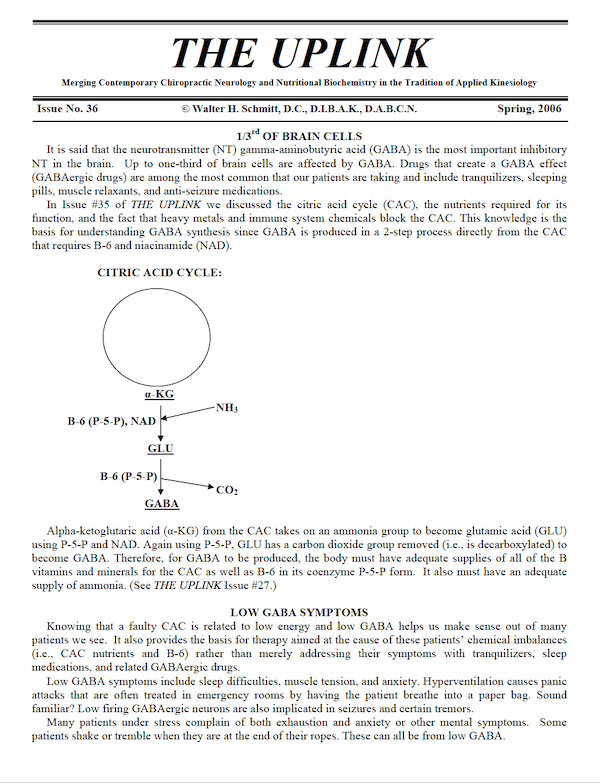
Dr. Schmitt was the first practitioner in the world to hold Diplomate status in both Applied Kinesiology (DIBAK) and Chiropractic Neurology (DABCN). Dr. McCord served as his teaching assistant and colleague and is the primary author of the QA Clinical Reference Manual, which comprehensively documents the techniques and procedures taught in the QA Course.
The complete Course includes:
- Live recordings of all 16 sessions
- 49 supplemental session-by-session webinars
- The QA Book
- Dr. Schmitt’s Audio reading and commentary on his award-winning paper “ A Neurological Rationale for a Comprehensive Clinical Protocol Using Applied Kinesiology Techniques”
- Clinical forms, peer-reviewed papers, and supporting material
QA Session 1 (IRT & Pain Relief Techniques) introduces the first steps of the QA Clinical Protocol, explores the use of manual muscle testing as a window into neurological function, and teaches four powerful hands-on techniques:
- Injury Recall Technique (IRT)
- Nociceptor Stimulation Blocking (NSB) Technique for acute pain
- Set Point Technique for the relief of both acute and chronic pain
- and Location, Quality, and Memory (LQM) Technique for pain that has persisted for months or years and has not responded to the other procedures taught in the QA Course
From there, the QA Course progresses through structural, neurological, biochemical, immune, digestive, endocrine, metabolic disturbances, and more while continuing to build your expertise in applying the principles embodied in the QA Protocol.
Who is QA for?
QA is for you if you want a repeatable framework for deciding what to do first, next, last, and why.
QA is for you if you want to understand the relationships between structural, biochemical, neurological, and other findings rather than treating them as isolated pieces of a puzzle you may not otherwise be able to solve.
QA is for you if you want to learn a comprehensive system of analysis and therapeutics that provides an open framework for clinical thinking incorporating all techniques and procedures from the past, present, and future.
QA may not be the best first purchase if you’re only interested in a specific clinical topic.
If you are currently only interested in the mechanics and application of manual muscle testing procedures.
Or, if you want a less comprehensive introduction before deciding whether this approach is right for you.
In those cases, one of the other courses or free options in this guide may make more sense.
Can Beginners In AK Benefit From Taking The QA Course?
Yes.
You do not need previous Applied Kinesiology experience to enroll in and benefit from the QA Course.
However, if you’ve never performed manual muscle testing before, learning and practicing that skill separately can make the learning process easier. That’s where Muscle Testing Training can be useful.
Try QA Before Deciding
A free trial of QA Session 1 is available on our home page.
If you want to determine whether the QA Course and Dr. Schmitt’s teaching style are right for you, this may be the best way to find out.
Buying The QA Book

Best for practitioners who are familiar with AK and, of course, for those who have studied with Dr. Schmitt and/or have taken the QA Course.
The QA Book, now in its Memorial 3rd Edition, provides ready access to the techniques and procedures of the QA Clinical Protocol for use during patient care. A comprehensive appendix provides supporting materials, and the book is fully indexed for easy reference. The QA Book is included with the QA Course and is also available for purchase separately.
Of course, you don’t need to purchase the book separately if you’re buying the complete QA Course.
You might want to purchase it separately if you want the reference manual for the procedures and techniques without enrolling in the QA Course.
If You Already Own The QA Course: What’s Next?

Although there isn’t one mandatory “next course,” once you’re studying and/or using QA, a variety of resources and enhancements are worth exploring.
Some deepen your day-to-day knowledge of QA and the nuances of its application. Others focus on specific neurological or clinical subjects. Another addresses the business side of building a QA-oriented practice.
Your next step, then, depends on what you need or want at this point in your clinical journey toward outstanding outcomes.
Ongoing QA Education
QA Enhancement Webinar Library
Best for QA practitioners who want ongoing clinical education and access to an extensive library of webinars and seminars that build on the QA Course.
The ever-expanding QA Enhancement Webinar Library includes more than 250 hours of recorded webinars and seminars, along with written clinical procedures that expand on and enhance material taught in the QA Course.
Because most of the library builds directly on material taught in the QA Course, practitioners generally get substantially more value from these resources after enrolling.
There are, however, exceptions. Some webinar topics, including the medication webinars, stand on their own. Practitioners with years of experience using AK, as well as those who previously studied with Dr. Schmitt, have also found the library extremely useful.
The live question-and-answer material is also included and has broad appeal.
This probably isn’t the best starting point if you’re completely new to AK and QA. Much of the content refers to concepts taught in the QA Course.
However, for practitioners already familiar with AK who aren’t ready to invest in the QA Course, the webinar library offers an affordable introduction to the way QA practitioners think, along with practical clinical material you can begin using in your office right away.
And if you are curious, a free trial is available.
Advanced QA Training
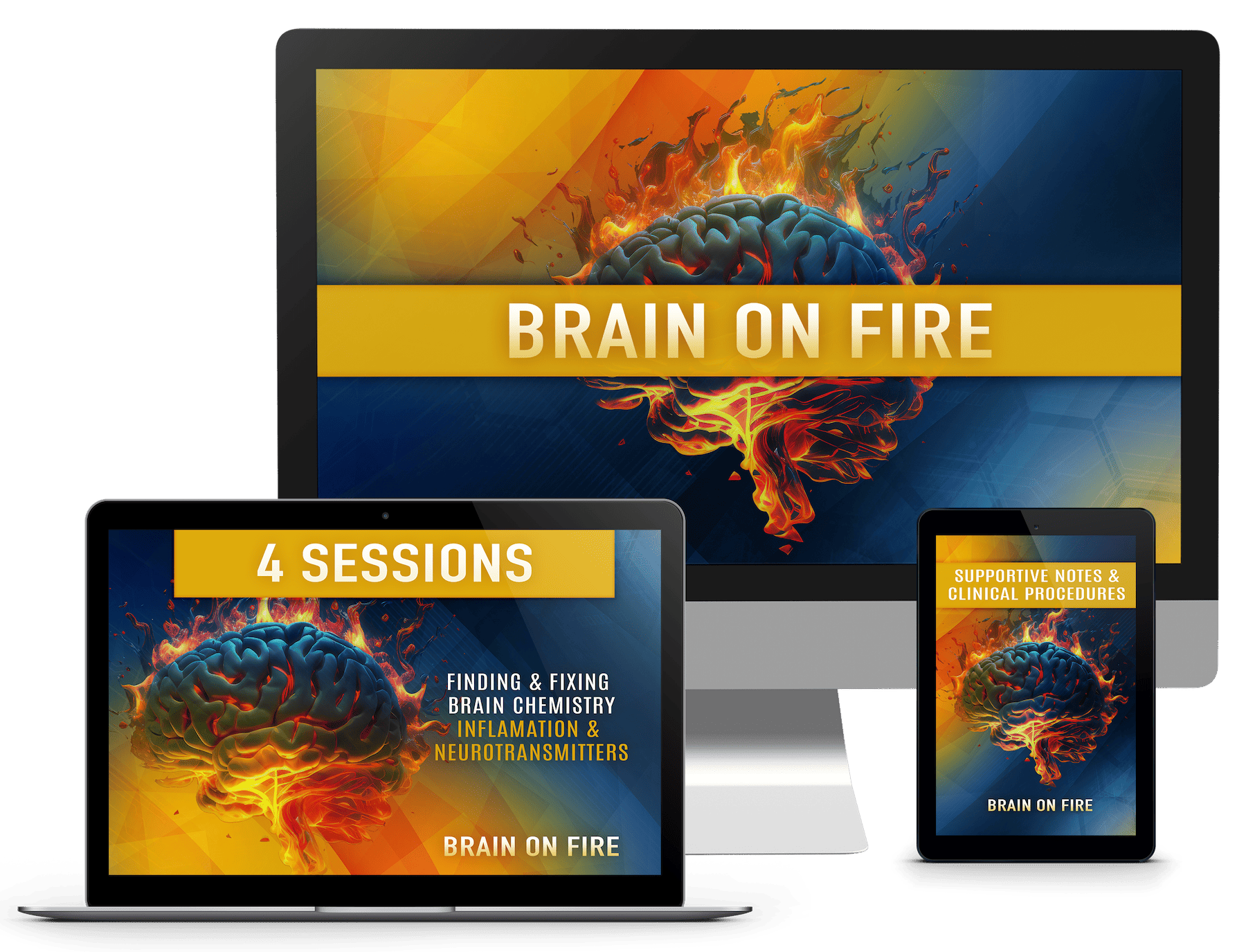
Brain on Fire
Best for experienced QA practitioners working with complex cases in which neurological and brain-related factors are primary.
Brain on Fire is advanced clinical training.
The QA Course is the recommended prerequisite, and you should understand substantial portions of QA before beginning the program.
If you’re new to AK or just beginning QA, Brain on Fire is probably not for you.
That isn’t a judgment about experience or ability. The Brain on Fire Course assumes you are familiar with the QA curriculum, and you’ll get considerably more from it once that foundation is in place.
If you’ve completed the relevant QA material and want to dive deeper into complex cases, Brain on Fire is the appropriate next step.
QA Practice Development and Clinical Mentoring
Mentoring Course: Practice Building, Practice Management & QA Clinical Mastery
Best for practitioners who want to develop or transition toward a QA-oriented, lower-volume cash practice.
This Mentoring program focuses on how you build a low-volume, cash practice while continuing to develop your understanding and application of the principles taught in the QA Course.
The program follows Dr. McCord as he mentors a fellow practitioner who moved from North Carolina to Colorado and wanted to transition from a high-volume practice to a lower-volume, QA-oriented cash practice.
As you will discover if you choose this path, “low volume” is relative.
For one doctor, that might mean moving from 100 patients per day to 15. For another, it could mean moving from 25 patients per day to three, four, or five.
The underlying question is this: How do you structure a practice that gives you the time you need to provide the kind of care you want, while remaining economically viable?
This is probably for you if you value the QA approach, have seen its impact on your practice, and want help structuring your practice to allow more time for increasingly complex cases, deepen your clinical expertise, or reduce patient volume while maintaining a financially sustainable practice.
This probably isn’t for you if you’re trying to learn Applied Kinesiology or QA. You should most likely start with the clinical courses first.
A Cash Practice mini-course is available for free if you’d like to preview the approach and see if it is what you want or need.
Focused Clinical Training
No Stuff Stuff & Neurological Tools for Daily Use
Best for AK practitioners specifically interested in this material and who do not already subscribe to the QA Enhancement Webinar Library.
This two-seminar package provides practical neurological tools for daily use, along with approaches for those times when you don’t have access to your test kit. Both seminars offer clinical insights and procedures that can be incorporated immediately into daily practice.
There is one more important thing to know before buying it:
If you already subscribe to the QA Enhancement Webinar Library, this material is included in your subscription.
So, be sure to check your existing access before purchasing it separately.
Synchronizing the CNS
Best for AK practitioners who specifically want the knowledge presented in the Synchronizing the CNS webinar series without subscribing to the webinar library.
This webinar series focuses on specific procedures designed to identify and remove hidden barriers to optimal CNS function before proceeding with further evaluation and treatment.
As with No Stuff Stuff & Neurological Tools for Daily Use, this material is included in the QA Enhancement Webinar Library.
You probably don’t need to purchase this separately if you’re already an Enhancement Webinar Library subscriber.
To Sleep or Not to Sleep
Best for AK practitioners who want focused training related to sleep.
The To Sleep or Not to Sleep webinar series brings together a wide range of information on sleep disturbances and related interventions, complemented by supporting materials. The package also includes the recorded live seminar in which much of the material explored in the webinar series was originally presented.
Like the two programs above, this material is also included in the QA Enhancement Webinar Library.
So, the decision is fairly simple:
If you’re primarily interested in the material on sleep, purchasing the individual package may make the most sense.
If you’re interested in this material as well as other webinars and seminars in the QA Enhancement Webinar Library, a library subscription may make more sense than purchasing the programs individually.
Other Specialized Courses and Clinical Resources
Not everything in the QA Home Study store is part of the QA curriculum itself.
We also offer selected courses and complementary resources from AK practitioners that may provide additional tools to support your clinical practice.
These can be chosen based on your specific needs rather than a prescribed sequence of study.
Retained Neonatal Reflexes
This course focuses on primitive or retained neonatal reflexes and their integration.
Important: An Applied Kinesiology background is required.
If you’re completely new to AK, this is not the place to start. Build your foundation first and, if interested, return to this course when the material is appropriate for you.
The Lebowitz Protocol
The Lebowitz Protocol focuses on diagnosing and treating dysbiosis (fungal, bacterial, parasitic, viral, Lyme), food reactions, metal and chemical toxicity/sensitivity, and more.
Muscle-testing skill is recommended.
This is probably for you if you’re already comfortable with manual muscle testing and specifically want to learn the Lebowitz approach to complex cases.
This isn’t for you yet if you haven’t had any experience with manual muscle testing.
QA Vial Test Kit
The QA Vial Test Kit was produced by Dr. Carl Amodio in cooperation with Ergopathics Canada and is a clinical testing resource for practitioners who use vial-based testing and want a kit designed to support the QA Clinical Protocol.
If you don’t use vial testing, this is not for you.
Charting Hero
Charting Hero is an AI-powered clinical documentation tool designed to help practitioners with charting.
You don’t need an AK or QA background to use it.
So if you’ve landed on this article looking strictly for clinical education, you can skip this one. If clinical documentation is taking too much of your time, this is definitely worth a look.
How Credits For Previous Purchases Work
One reason practitioners sometimes hesitate to start with a smaller portion of the overall curriculum is the concern that they may eventually have to pay for the same material again.
The good news is that we’ve taken steps to prevent that.
If you purchase the AK 100-Hour Course and later enroll in the QA Course, the full purchase price of the AK 100-Hour Course can be credited toward your QA Course purchase.
Similarly, if you purchase individual QA Sessions and later decide to complete the full QA Course, those purchases can also be credited toward the remaining sessions.
In other words, you don’t have to make the biggest commitment on day one simply to avoid paying twice later.
You can start where you’re comfortable and move forward if and when it makes sense for you.
Still Not Sure Which Course is Right For You?
If you’re not sure which next step to take in your clinical journey, here’s a decision-making process for your consideration.
“I’ve never done muscle testing.”
If you want to concentrate specifically on developing your muscle-testing skills first, start with Muscle Testing Training.
If you want a broader foundation in Applied Kinesiology, consider the AK 100-Hour Course.
Or, if you want the most comprehensive approach from the beginning, you can start directly with the QA Course, where manual muscle testing is taught as part of the curriculum.
“I practice AK, and know lots of techniques, but don’t always know what to prioritize.”
The QA Course is definitely for you.
That is precisely the problem the QA Protocol was developed to address.
“I just want to see what QA is like.”
Take the 7-day free trial of QA Session 1.
Or, if you want something you can own and work through at your own pace, start with the $17 Injury Recall Technique Fast Start Program.
“I’m mainly interested in nutrition.”
Look at Clinical Nutritional Pearls 1 & 2 and Immune System & Digestive Mastery.
Neither requires an AK or muscle testing background, and both have free introductory mini-courses.
“I already own QA and want more clinical material.”
You are definitely ready for the QA Enhancement Webinar Library.
If you’re only interested in a particular subject, one of the individual webinar packages may make more sense.
“I’m already well into QA and want advanced neurological training.”
Brain on Fire should be considered as your next step in your clinical journey
“I want to change the way my practice operates.”
Look at the Mentoring Course, particularly if your goal is a lower-volume, QA-oriented, cash practice.
“I only need one particular skill or resource.”
Then don’t buy a larger course just because it comes earlier on some imaginary curriculum ladder.
Look at the specialized courses and resources above and choose the one that best fits what you want to learn or accomplish.
Frequently Asked Questions
Do I Need Applied Kinesiology Experience to Take the QA Course?
No. Previous AK experience is not required. Manual muscle testing is taught within QA, although developing some proficiency beforehand may make the learning process easier.
Which Courses Don’t Require Muscle Testing?
Clinical Nutritional Pearls 1 & 2, Immune System & Digestive Mastery, and Mastering Medications do not require expertise in AK or manual muscle testing.
Of course, Charting Hero doesn’t require it either, since it is a clinical documentation tool rather than a clinical course.
What’s the Difference Between the AK 100-Hour Course and the QA Course?
The AK 100-Hour Course teaches the foundational techniques and principles of Applied Kinesiology.
The QA Course includes and expands on that foundation, but goes considerably further by organizing clinical evaluation and treatment into a comprehensive 32-step system.
In simple terms, the AK 100-Hour Course focuses primarily on learning AK tools. QA teaches those tools while also teaching the clinical thought process for determining what to address first, next, last, and why.
You do not need to take the AK 100-Hour Course before taking QA. If you want the more comprehensive system from the beginning, you can start directly with the QA Course.
If you prefer to begin with a smaller foundational AK curriculum, you can start with the AK 100-Hour Course. If you later move on to QA, what you paid for the AK 100-Hour Course will count toward the cost of the QA Course.
Do I Need to Buy the QA Book Separately?
The QA Book is included when you purchase the QA Course. It is also available separately for practitioners who specifically want the clinical reference manual or need more than one for their unique circumstances.
Do I Need the QA Enhancement Webinar Library if I Own the QA Course?
No. The QA Enhancement Webinar Library is not required.
The library becomes more useful as you progress through the QA Course because much of its content builds on and enhances QA concepts and procedures.
Should I Buy the Individual Webinar Packages or become a member of the QA Enhancement Webinar Library?
It depends on what you want.
No Stuff Stuff & Neurological Tools, Synchronizing the CNS, and the Sleep Webinar series are included in the QA Enhancement Webinar Library.
However, if you only want one particular webinar series, buying it separately may make sense, and you will own it for life.
If you want ongoing access to a much larger collection of QA education, the ever-expanding QA Enhancement Webinar Library membership is for you.
Do any of the courses qualify for continuing education credits?
Yes. The QA Course is accredited for continuing education credits through PACE in AK, AR, KS, MA, ME, MN, NC, ND, NJ, NV, OK, SC, SD, and TN, and credits are available for each session.
To receive them, pass the quiz at the end of each session, then email support@qahomestudy.com to request credit for the sessions you have completed. If you are licensed in a profession other than chiropractic, check with your own licensing board about whether PACE-accredited courses are accepted.
You Don’t Have to Choose Everything. Just Choose Your Next Step.
There isn’t just one course on the QA Home Study site that every practitioner needs, with the possible exception of the QA Course, which is our flagship offering recommended for every practitioner seeking clinical certainty and outstanding clinical outcomes.
With this one possible exception, we’ve tried to tell you not only what each offering provides, but also when it doesn’t make sense.
If you’re brand new to manual muscle testing, you might want to start there.
If you already know AK and want an organized clinical roadmap to enhanced results, consider the QA Course.
If nutrition is your primary interest, you can begin there whether or not you know manual muscle testing at all.
And if you already practice QA, choose the advanced training or ongoing education that addresses what you want to work on next.
Browse all QA Home Study Courses and Resources
Or, if you’d like a test drive, try QA Session 1 free for 7 days.