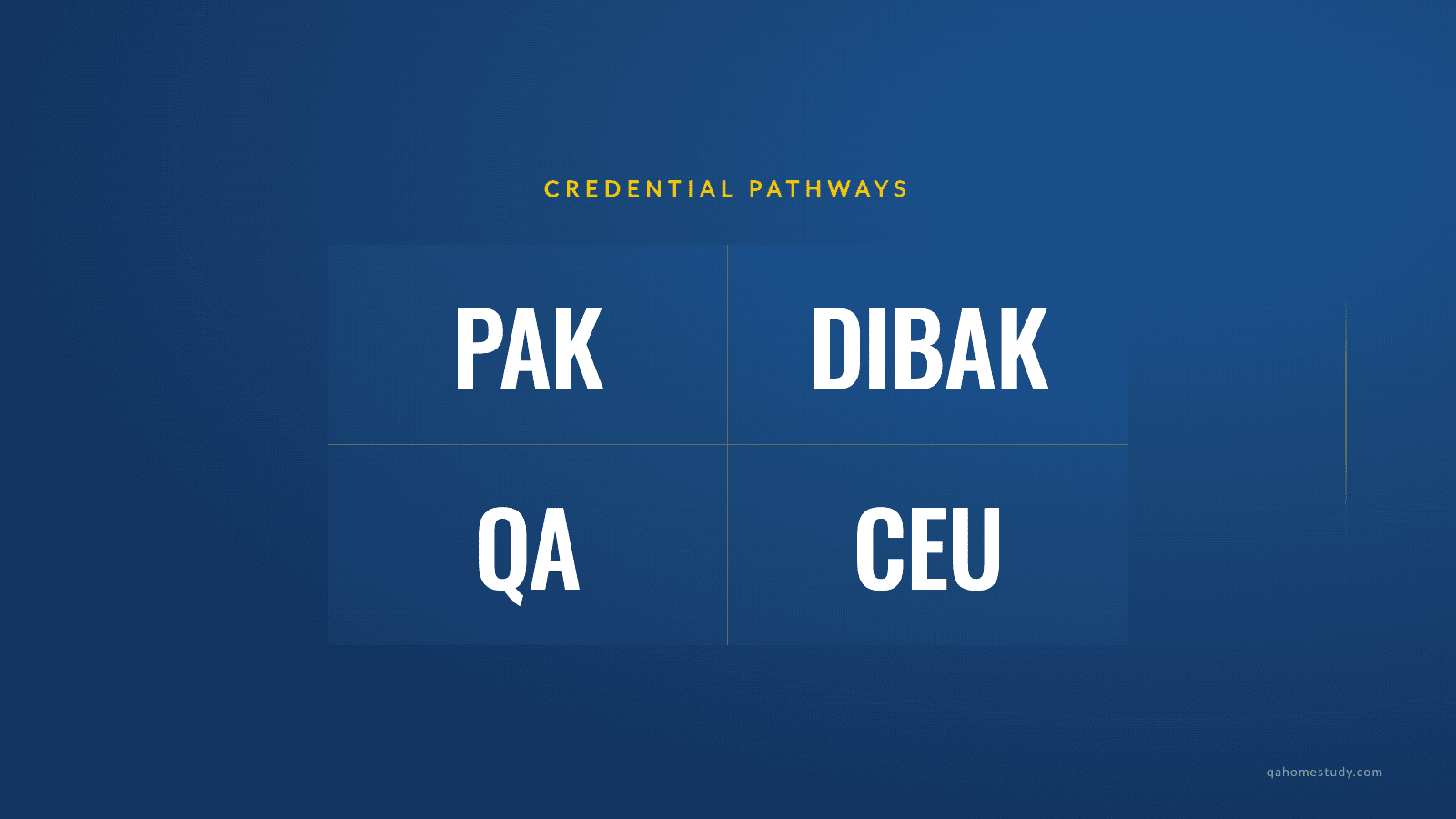
Healthcare practitioners often ask about applied kinesiology certification, but the term “certification” covers several different pathways that are easy to confuse.
Some want to pursue Professional Applied Kinesiology (PAK) certification through the International College of Applied Kinesiology (ICAK).
Others want applied kinesiology (AK) Courses (live or online) that offer hours that count toward ICAK Diplomate certification (DIBAK).
Some are looking for AK Courses that offer continuing education credits (CEUs) for their license type.
And some want to know whether QA Home Study grants any credentials.
Four overlapping questions, each with its own answer.
Two of these pathways lead to ICAK credentials, so let’s start there. The ICAK Board of Examiners (IBE) administers the primary credentialing process in AK, offering two formal certification examinations.
- Professional Applied Kinesiology (PAK Certification)
- Diplomate in Applied Kinesiology (DIBAK Certification).
Continuing education credits (CEUs) are governed separately by each practitioner’s licensing board, and QA Home Study offers its own pathway through an ICAK-approved curriculum, the Quintessential Applications (QA) Course, with Level 1 and Level 2 Proficiency Examinations. The Quintessentail Applications Course is certified in many U.S. states through PACE.
ICAK Certification: Who qualifies and what’s available
The ICAK defines the practice of AK as “limited to health care professionals licensed to diagnose”. Clinical decisions require standard diagnostic methods. As a result, not every practitioner who benefits from muscle testing is eligible to sit for the ICAK certification examinations.
Practitioners with a verified license to diagnose (e.g., chiropractors, medical doctors, osteopaths, acupuncturists, and others ) can pursue PAK and DIBAK certifications by examination.
The PAK designation
Professional Applied Kinesiology (PAK) is the first formal credential that the ICAK administers.
To earn PAK certification, a practitioner must:
- Be a current member of ICAK
- Complete an AK 100 Hour Course taught by a DIBAK-certified teacher
- Pass both a practical and a written examination
- Recertify every 5 years by attending at least one ICAK Annual Meeting
PAK certification is awarded, but must be maintained. The five-year recertification cycle keeps practitioners connected to ICAK’s evolving curriculum and to the advances of their peers in the AK community.
In 2024, the ICAK’s International Council, the body that sets and enforces global standards for AK education, research, and clinical practice, ruled that 30 of the 100 required hours for PAK certification must be live, in-person, hands-on workshops.

The DIBAK designation
The Diplomate in Applied Kinesiology (DIBAK) certification is the highest credential that the ICAK administers.
Requirements for the DIBAK certification include:
- Be a member of your ICAK chapter for 1 year, and have attended at least one meeting
- Complete a minimum of 3500 undergraduate professional education hours or equivalent
- Complete a minimum of 300 hours of approved AK instruction taught by at least 2 certified teaching AK Diplomates
- Complete three years of practice using AK procedures and techniques
- Write two original (or research) papers for the ICAK, fulfilling the Diplomate paper guidelines of the International Board of Examiners of the ICAK (IBE)
- Pass a 5-part written examination on various AK topics
- Pass an extensive practical examination
The 300 hours of post-graduate AK instruction and other requirements mean the Diplomate status in Applied Kinesiology represents a long-term clinical commitment. The two research papers add a scholarly contribution.
Practitioners who hold DIBAK certification are not only well-trained but also active contributors to the field’s growing evidence base.
The rules regarding live, in-person, hands-on workshops reported above for PAK (30%) also apply to the DIBAK 300-hour accumulation.
As with PAK certification, confirm the current approved curriculum and hours of live workshops required to support online learning by contacting the ICAK.
Online Hours and QA Home Study
Many of the offerings available on QA Home Study are ICAK-approved curricula.
Your primary instructor in these Courses is Dr. Walter “Wally” Schmitt, the first practitioner in the world to hold Diplomate status in both applied kinesiology (DIBAK) and chiropractic neurology (DABCN). More about Dr. Schmitt’s career and training here.
Those enrolled in the QA Course, QA Home Study’s flagship offering, can earn certification through two examinations:
- QA Level 1 Proficiency Examination is available after completing QA Sessions 1-7, and muscle-testing proficiency verified by an AK teaching Diplomate
- QA Level 2 Proficiency Examination is available upon completion of QA Sessions 8-15 and submission of 2 case studies
For those pursuing hours toward applied kinesiology certification (PAK or DIBAK), confirm the current approved curriculum and live workshop requirements by contacting the ICAK directly.
Where does the QA Course fit?
The QA Course delivers a clear path towards clinical mastery.
Dr. Schmitt’s 16-session QA comprehensive curriculum provides a context for clinical thinking based on normal physiological, biochemical, and neurological principles (the QA Clinical Protocol).
Dr. Schmitt’s teaching assistant and colleague, Dr. Kerry McCord, the primary author of the QA Clinical Reference Manual and the catalyst for the creation of the QA Course, has often remarked: “The order in which we apply our techniques and procedures is more important than the techniques themselves.”
Dr. Anita Ginter, a German medical doctor and Diplomate in AK, described it this way: “QA enabled me to get results I never dreamed of. It’s comprehensive and worth learning for anyone interested in AK.”
For Dr. Ginter, QA training and DIBAK certification were parallel pursuits, each reinforcing the other.
The QA Course includes Level 1 and Level 2 Proficiency Examinations.
These examinations assess mastery of the concepts and procedures, and evaluate the practitioner’s understanding of the clinical application of the QA Protocol.
Although these QA certifications are not ICAK credentials, passing either one demonstrates fluency in the QA Clinical Protocol.
Manual muscle testing, postural analysis, Chapman’s reflexes, therapy localization, and more are all part of fundamental AK education. The credentialing pathways, however, are distinct. Certification in one pathway doesn’t necessarily qualify you for another. For a broader overview of what applied kinesiology is and how it works clinically, see the full practitioner’s guide.
From a patient’s perspective, the clinical outcome matters more than the doctor’s credentialing timeline. Practitioners who study AK and QA see changes in patient outcomes long before they’ve completed any QA or ICAK examination.
To be clear, this isn’t an argument against credentials. It’s a recognition that a doctor’s clinical expertise matters more than the credentials they’ve earned by examination. QA Home Study grants proficiency in the application of the QA Clinical Protocol.
The ICAK offers PAK and DIBAK credentials.
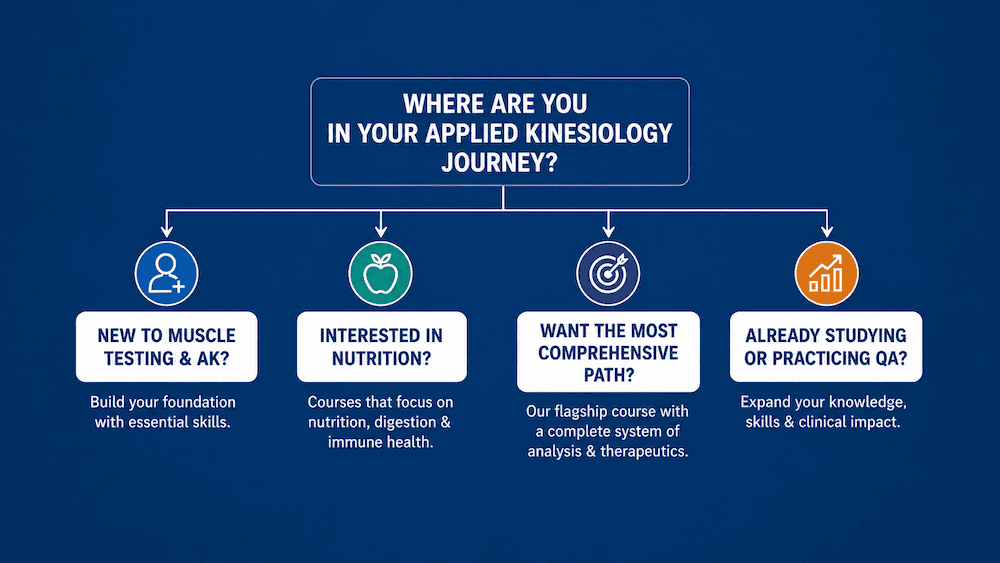
Choose your path
If you’re new to applied kinesiology, consider beginning with Dr. Wally Schmitt as your mentor.
Dr. Schmitt is widely regarded as one of the most respected and celebrated AK teaching Diplomates in the world, and his teachings live on through the QA Course. Learning AK fundamentals from him, along with powerful techniques like Injury Recall Technique within the framework of the QA Clinical Protocol (what to do first, next, last, and why), leads to better clinical outcomes.
A 7-day free trial to QA Session 1 (IRT & Pain Relief Techniques) is available at qahomestudy.com.
If PAK is your goal, Dr. Schmitt’s AK 100-Hour Course is approved online curriculum under ICAK’s framework. To sit for the PAK examination, you will need an active ICAK membership.
If DIBAK is your goal, you’re committing to 300 hours of ICAK-approved instruction, three years of practice, and two research papers before becoming eligible to sit for the written and practical examinations. We recommended mapping your course selections against ICAK’s approved curriculum.
If you’re already enrolled in or planning to enroll in the QA Course, Level 1 and Level 2 Proficiency Examinations are available when you’re ready.
Practitioners who want to teach can pursue the QA Workshop Leader pathway after achieving Level 2 Proficiency.
Frequently Asked Questions
What does DIBAK stand for?
DIBAK stands for Diplomate of the International Board of Applied Kinesiology. It is the highest credential issued by the ICAK. Requirements include 300 hours of AK instruction, three years in practice, two research papers, a 5-part written exam, and a practical examination.
What is the PAK designation in applied kinesiology?
PAK stands for Professional Applied Kinesiology. It is ICAK’s first formal credential. Requirements include 100 hours of instruction from an AK-certified teaching Diplomate, an active ICAK membership, and passing both practical and written examinations. To recertify, practitioners must attend at least one ICAK Annual Meeting every five years.
Does the QA Course count toward ICAK certification?
The QA Course is an ICAK-approved curriculum; however, the number of hours that count toward PAK or DIBAK eligibility depends on ICAK’s current approved-hours policy. The live workshop requirements may also apply to the study of QA. Contact the ICAK for the current ruling.
Can I get AK certification online?
Both the PAK and DIBAK certifications administered by the ICAK require in-person written and practical examinations.
As noted in the PAK section above, the ICAK’s International Council ruled in 2024 that 30 of the 100 required hours for PAK certification must be live, in-person, hands-on workshops. Similar requirements appear to apply to the DIBAK 300-hour requirement. Confirm the current approved curriculum and live workshop requirements by contacting the ICAK.
What’s the difference between a certificate of completion and AK certification?
A certificate of completion documents that you have completed a specific training program. Applied kinesiology (AK) certification (PAK or DIBAK) is a credential issued by the ICAK after demonstrating clinical competency through written and practical examination.
Many quality training programs offer certificates of completion. None of them, including the offerings available at QA Home Study, offers ICAK certification.
Is there a QA certification?
The QA Course offers Level 1 and Level 2 Proficiency examinations. These examinations assess mastery of the concepts and procedures taught within the context of the QA Clinical Protocol.
The QA Workshop Leader pathway is available for Level 2 proficient practitioners who want to teach. These are unique designations and are distinct from ICAK’s credentialing pathway.
Where to start
QA Home Study publishes new clinical content for AK practitioners every month. Add your email address below to get free articles, invitations, and information. No pitch, just improved clinical outcomes.